
BLOG: Green Community Hubs – Sarayu
For Community Projects Officer, Sarayu, Green Community Hubs offer much desired doses of positivity and inclusivity across inner city London. During her recent years working at Groundwork London, Sarayu has also observed a sharp rise in the social and environmental need for these vital Hubs – that promise people more than just gardening.
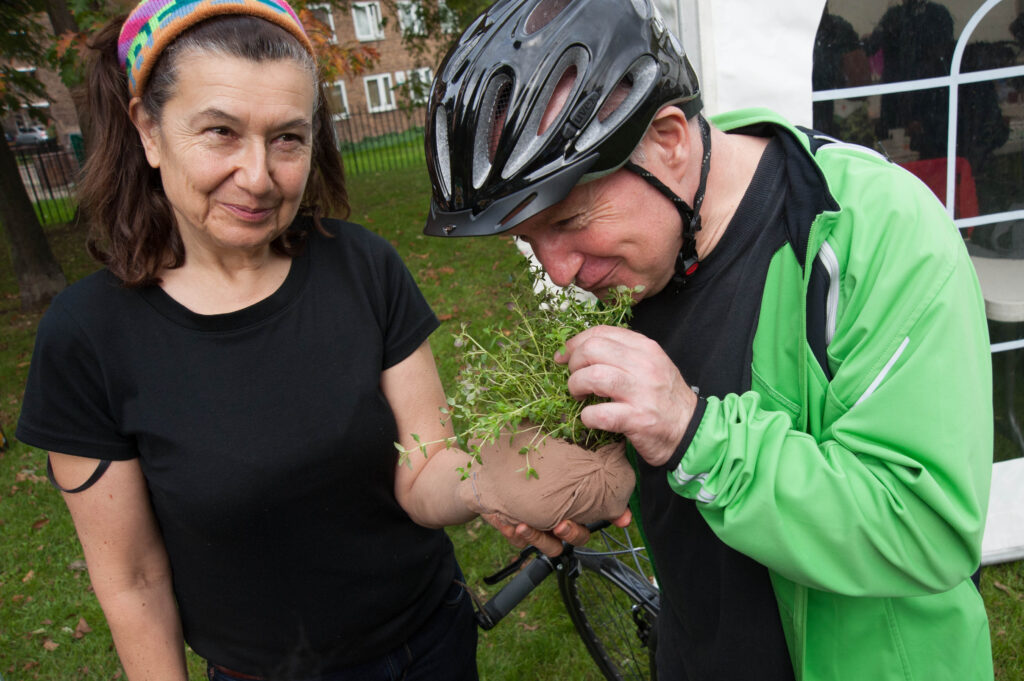
Sarayu has been working at Groundwork for 20 years. Over this period she has worked in project management; supervised and managed graduate interns and work placement students; created and designed workshop materials content and undertaken networking opportunities.
Delivering across a range of projects and programmes, her Community Project Officer role has made Sarayu an expert on Green Community Hubs and open green spaces.
Speaking of her role, Sarayu said:
“Green spaces are the antithesis of living in dense, crowded and polluted environments especially, but not exclusively, in urban areas. They can contribute to the social, environmental and information needs of people. They can go some ways to cultivating community cohesion and inclusion. They are spaces to breathe, to escape from the daily grind to de-stress, to take a step back, to combat loneliness, to add to the feel-good factor, to think, to engage in conversation or not, to try and to experience something different. It’s about making connections of whatever sort, perhaps leading to change and perhaps doing something outside of the usual. All over a nice cuppa tea of course.
“My favourite Green Community Hub memory is transforming an unusable and derelict space in Lambeth into a peaceful, comfortable and colourful space providing a much-needed place for the local community to meet in and enjoy. Decrepit and rusty swings were removed. The land was levelled and graduated in a clever and creative way to open up the space, and a fallen oak tree trunk was put in place for climbing on and sitting on, in keeping with as much natural play as possible. Boundaries were laid out ready for community planting days with the priority to add colour to the borders to make it a more welcoming and inviting place. It made people happy and proud to work together in their local area.”
Sarayu believes Green Community Hubs are sought after, and needed, now more than ever.
“Green spaces and Hubs are at a premium in inner cities. And never more so. My observations over all these years are that there has always been a need for these spaces, for all the myriads of social and environmental reasons. The years of Covid and its aftermath only accelerated the desire to seek out green spaces, anywhere and everywhere. The awareness of green spaces, using them, having them, protecting them was heightened. The energy crisis – and resulting cost of living crisis that is not going away – has given an added impetus to creating more food growing community spaces together. They have greater learning about biodiversity and ever-encompassing climate change issues, and how to tackle it.
“I think the Green Community Hubs offering and providing more than just gardening has contributed to people using services across varied communities. Once connections are made, interest can be generated into other activities. It is often about getting the information out to the right places in the community in the first place.
“These spaces inject high doses of positivity into the local community. Those involved in creating, maintaining and using them have a sense of pride about what they do and where they live. It can be contagious, drawing in others who want to get involved and strengthening the longevity of these valuable places. Hubs can be a catalyst to get things kick started and bring people together to act on local issues that might have been brewing over time. I see it like a skimming stone: creating ripples that spread out, allowing thoughts to surface and given time to turn into action.”
Sarayu knows what ingredients make a successful Community Hub. She has seen them grow herself:
“You make people feel welcome. Throw in bucketfuls of passion – it’s infectious. And time to let it grow and develop. Establish the roots. I have been lucky to observe this in real time over at least 15 years. Just around the corner from the Groundwork London office, on housing estate land adjacent to the pavement and bereft of any plants. One day I noticed a little tuft of grass had been dug up, the size of a spade. Literally it was the first dig. I continued to observe and sure enough more digs were added. It took a few years to dig the whole way down, by which time bulbs and flowers were planted. The person – who I subsequently found out was a woman – was testing it out. Little by little, giving time for reactions. To gather interest. It is now unrecognisable: a haven of plants and flowers and vegetables. I still walk down that street and admire it.
“Even better, on one corner of that estate, there was a disused piece of land boarded up. It is now a fully-fledged community green space. Power to the people. And that wonderful Margaret Mead quote comes to mind: “Never doubt that a small group of thoughtful, committed citizens can change the world; It’s the only thing that ever has.”
Her number one reason for community spaces is ‘more green and less grey every time’.
Community spaces protect and cultivate the natural world of which we all depend. They are ready made learning hubs: horticulture, food growing, gardening, herbs and herbal medicine, foraging, re-wilding, pollination, propagation, clean air, drought resistant planting, seed distribution, soil science, permaculture, ecology, the symbiotic relationships between the animal, plant and fungi kingdoms. We need more biodiversity to support all the different species of wildlife that need certain plants to survive. And us of course.
Find out more about the impact that Green Community Hubs are having on people and places across the UK.
Notes to editors
For more information please contact: media@groundwork.org.uk
About Groundwork
Groundwork is a federation of charities with a collective mission to take practical action to create a fair and green future in which people, places, and nature thrive. We support communities and businesses to build capacity and resilience in order to tackle hardship, achieve a just transition to net-zero and help nature recover in a way that reduces inequality and leads to healthier, happier lives for all: www.groundwork.org.uk