
BLOG – People-Centred Retrofit Support
Written by Phil Treaton, Strategic Lead for Retrofit
Our people-centred, data-informed retrofit support model is proving highly effective in reaching and supporting the most vulnerable households in Greater Manchester. Groundwork bridges the gap between complex national programmes and local communities, ensuring successful, high-quality installations.
In this blog, Phil Treaton, Strategic Lead for Fuel Poverty, Retrofit & Homes, breaks down our approach, what we have found works best and outlines some of the barriers we face in our delivery.
Our Aim: Building trust and driving system efficiency
We target households disproportionately affected by rising energy costs, establishing ourselves as a locally trusted service. We do this by providing:
- Reliable guidance & empowerment: we demystify the complex energy efficiency landscape, providing consistent, timely, and unbiased information. This ensures residents understand all available programmes and options, empowering them to make informed decisions.
- Accessible, personalised support: we provide hands-on, personalised assistance to overcome practical barriers, from application support to managing installation logistics, ensuring no resident is left behind.
Our Process: Fostering collaboration
We are a vital component of the local energy efficiency ecosystem, addressing key challenges faced by Local Authorities, housing associations and installers. We prioritise:
- Foundational support for installations: our early engagement model ensures residents are fully informed and prepared, significantly reducing delays and customer dissatisfaction, driving smoother and more efficient programme delivery.
- Trusted referral pipeline: we generate a consistent, assessed pipeline of eligible referrals for contractors. Our status as a trusted partner to Local Authorities and health providers facilitates information sharing, accelerating programme delivery and focusing contractor resources on installation quality, not lead generation.
- Strengthening the advice network: by actively integrating with the local advice network and training other frontline workers, we multiply our reach and ensure comprehensive, holistic support for residents with overlapping needs.
Our Model: A foundation for impact
We take a four-part approach to our retrofit support:
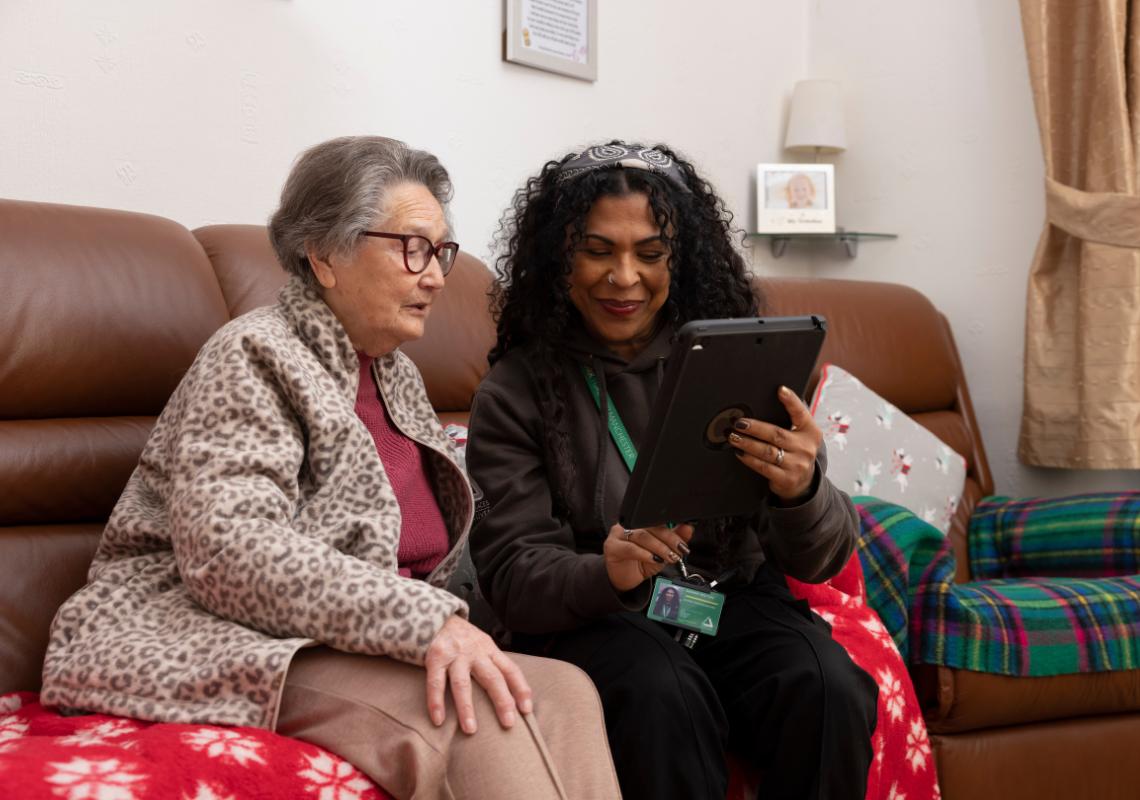
- People centred: home visits and taking time to listen carefully builds trust and ensures measures are tailored to individual homes. Signposting to complementary services addresses wider barriers to wellbeing. The benefit of this is high resident engagement and satisfaction, reducing drop-out rates.
- Data informed targeting: pre-checking publicly available data (house build and EPC ratings, Indices of Multiple Deprivation) allows us to carefully target support to specific streets and households most likely to be eligible and benefit. This approach maximises resource efficiency and ensure high quality leads for installers, driving cost-effective outreach.
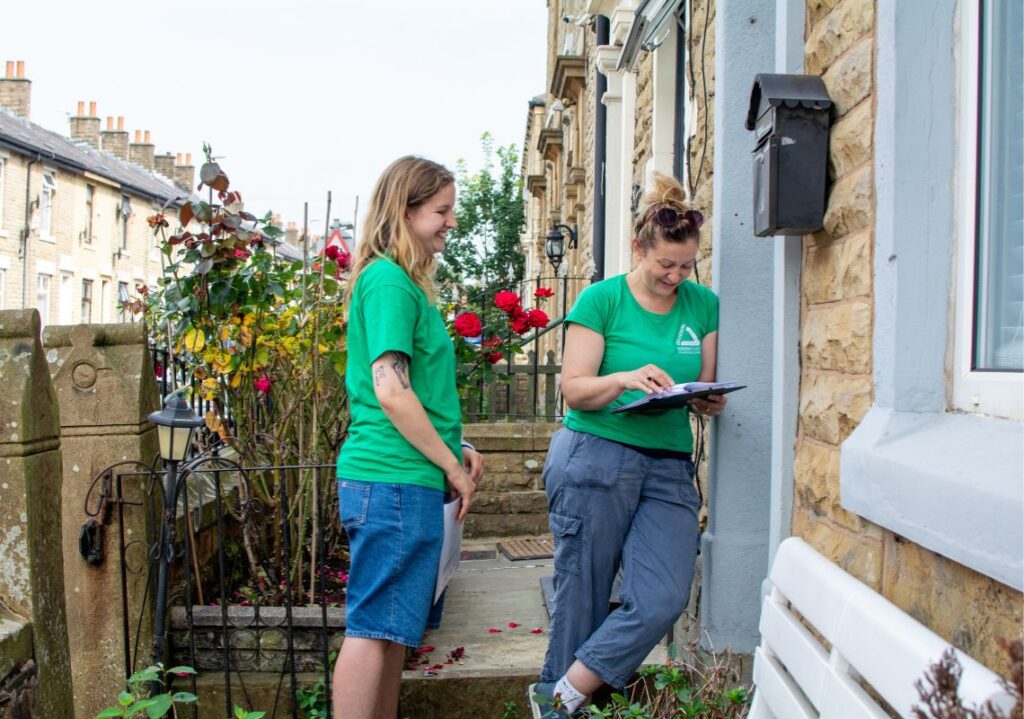
- Hyper-local outreach: working street-by-street using tailored methods (door-knocking, community events, drop-ins and digital outreach) ensures comprehensive coverage. Use of drone technology supports before-and-after images of properties providing compelling visual evidence of the effectiveness of retrofit measures that we can share with neighbours. Training other frontline workers and community champions acts as a multiplier for basic advice and referrals.
- Partner challenge and finding solutions together: we actively work with installation teams to resolve complex eligibility or technical issues, sharing best practices and championing solutions that ensure equitable access to energy efficient technologies. This ensures that support reaches challenging-to-treat homes.
Our success
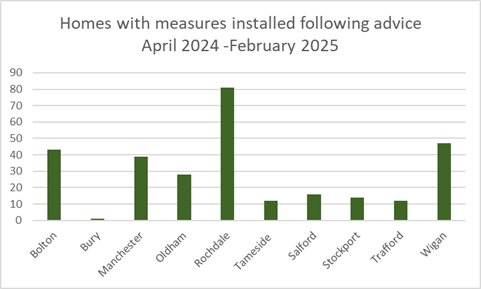
Our model has been successfully applied across Rochdale, Manchester, Tameside, and Oldham under the GMCA ‘Feel the Benefit’ campaign. Data confirms a direct and positive correlation between intensive engagement activities and the number of homes proceeding to assessment and installation where there is a long local track record. Success has been strongest in Rochdale, where our long-standing presence, official recognition, and deep network connections have created a stable foundation of trust and operational efficiency.
Learning what works
- The model: investment in our CRM enabled more effective targeting and referral into the most appropriate programme of support, accurately targeting our outreach and seamlessly referring residents to the most appropriate programmes, ensuring resources are used efficiently.
- Partnership: Being a named referral organisation in the Local Authority’s ‘Statement of Intent’ provides crucial legitimacy and solidifies our position as a reliable resource.
- Delivery: the ability to refer to a number of different installers allows us to match resident needs and complex property requirements to an installer’s specific strengths.
Systemic barriers to scaling retrofit
- Grant thresholds do not cover full installation costs: current funding guidelines frequently leave a significant gap between the available grant and the true cost of improvement, creating an insurmountable financial barrier for the target demographic. This is particularly evident in the following common scenarios:
- Properties requiring first-time mechanical ventilation alongside insulation.
- Loft insulation installations where existing boarding/storage requires removal and reinstatement.
- Installing cavity wall insulation on properties smaller than 110m2
- Off-gas flats lacking roof access, requiring non-standard external measures.
- Eligibility thresholds do not reflect current economics: fixed household income thresholds are failing to keep pace with wage increases, especially the National Minimum/Living Wage, inadvertently excluding the intended beneficiaries. As an illustration, in 2020, a two-person household with full-time employment at the living wage earned less than £31,000 annually, meeting the income threshold for programme support. However, projected earnings for the same household in 2025, approximately £36,000, would exclude them from a number of available retrofit programmes. Our decade of experience shows that this increased income does not correlate with an improved financial capacity to fund energy-efficiency installations independently. The household’s ability to pay remains static, while their eligibility is removed resulting in the ongoing exclusion of those who remain in fuel poverty.
- Consumer confidence in undertaking retrofit has been affected by negative publicity and failed schemes: DESNZ and the National Audit Office report published in October 2025 notes that there have been clear failures in the design and set-up of ECO4 and GBIS schemes and their consumer protection and quality assurance system in particular, combined with negative publicity highlighting the consequences when schemes do go wrong creates scepticism within the target audience, the same reports however point out that having independent scrutiny of delivery has alleviated many of the issues experienced. Read more on this here.

Phil Treaton
Strategic Lead – Fuel Poverty, Retrofit & Homes